
For the residents of Casey Key, protecting their community is about more than preserving one of Southwest Florida’s most beautiful places. It is also about maintaining the safety, peace and quality of life that make the Key such a special place to call home.
Over the past several years, homeowners have raised growing concerns about activity surrounding the Nokomis Beach Boat Ramp and nearby areas. Loud music, vehicles racing and doing donuts, groups gathering around the ramp, speeding and other disruptive behavior have increasingly affected residents—particularly those living closest to these public areas.
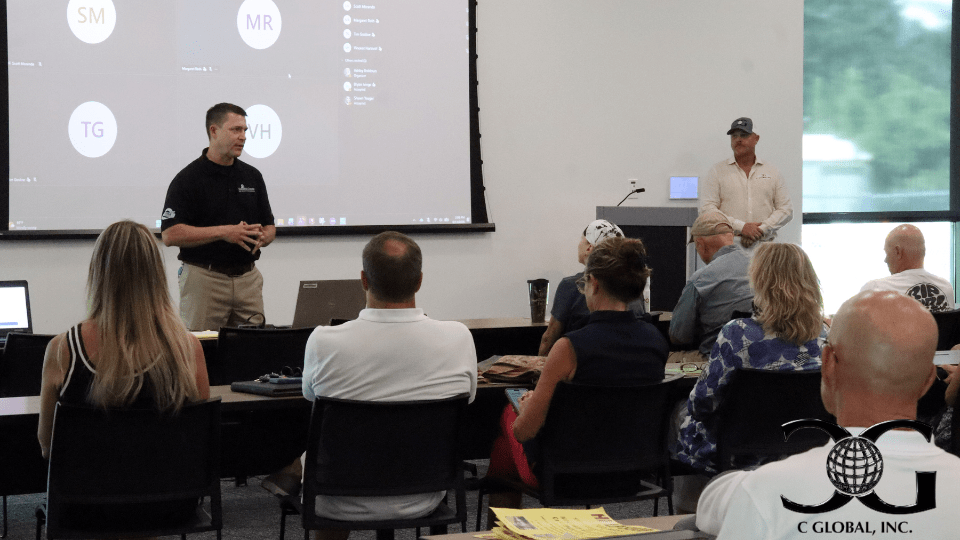
After hearing these concerns, Zack Clark of C Global organized a community meeting on August 11, 2026, bringing Casey Key homeowners together with representatives from the Sarasota County Sheriff’s Office (SCSO), Sarasota County Parks, Recreation and Natural Resources (PRNR), and C Global.
The goal wasn’t to point fingers. It was to put the people experiencing the problems in the same room with those who could help address them, provide residents with accurate information, and continue working toward practical solutions.
As Zack emphasized at the beginning of the meeting, everyone in the room was ultimately on the same team and working toward the same goal. Residents were encouraged to openly voice their concerns while approaching the conversation collaboratively rather than assigning blame.
Listening to the People Who Live Here
For homeowners, these concerns aren’t theoretical. They are happening outside their homes and along roads they travel every day.
One resident living approximately 110 yards from the boat ramp described music loud enough to shake the windows of his home. Others spoke about vehicles doing donuts, peeling out and speeding through the area. Residents also raised concerns about young people riding in the backs of pickup trucks, bridge jumping, trespassing and other activities that have created both disturbances and potential safety hazards.
One longtime resident, who has lived in the area for 46 years, explained that the severity of what homeowners are currently experiencing is relatively new, developing primarily over the last four to five years.
The discussion also made clear that homeowners aren’t simply asking for a quieter neighborhood. There are legitimate concerns about reckless driving, pedestrian and bicycle safety, accidents, property access and the possibility of someone getting seriously hurt.
Those concerns deserve to be heard.
But just as important, the meeting provided an opportunity to recognize something that can sometimes get lost when a community is dealing with an ongoing problem:
Progress is already happening.
Changes Are Already Making a Difference
Many of the solutions discussed by Casey Key homeowners over the past several months are no longer just ideas. Sarasota County, PRNR and SCSO have already taken action on a number of them.
Additional signage has been installed at the Nokomis Beach Boat Ramp identifying restrictions including no overnight parking or camping, designated boat-trailer parking and limitations on access to certain portions of the area between 10 p.m. and 6 a.m.
The boat ramp itself remains accessible 24 hours because of its geographic importance to boaters, but the new signage provides something law enforcement previously lacked: clearer rules that can actually be enforced.
That distinction is important.
SCSO explained during the meeting that the Sheriff’s Office had worked with PRNR to develop signage with language clear enough to provide deputies with enforcement ability.
At the time of the August meeting, that new enforcement capability had only been in place for approximately four to five weeks.
And there has already been noticeable improvement.
Residents attending the meeting acknowledged that increased law-enforcement presence and enforcement efforts have made a difference. SCSO was also optimistic that improvement would continue now that deputies have clearer authority to enforce the posted rules.
In other words, some of the most important changes made in response to community concerns are still very new.
Giving Solutions Time to Work
When a community has dealt with disruptive behavior for several years, it is understandable to want an immediate solution. But changing patterns of behavior takes time.
New signs don’t instantly change habits.
Enforcement doesn’t immediately reach every person who uses the park.
And people who have become accustomed to using an area in a particular way need time to learn that the expectations—and the consequences—have changed.
That is why the next several months will be important.
As people become familiar with the new restrictions and deputies have more opportunities to consistently enforce them, the impact of these changes may become even greater.
SCSO has also taken additional proactive measures. The Sheriff’s Office has increased attention on Nokomis Beach and Casey Key, adjusted patrol zones to improve service, and continued patrols of the area. South County Patrol Captain Ivings shared that he personally patrols Nokomis and Casey Key as part of his routine and has been directly involved in reviewing the signage and conditions at the boat ramps.
According to information presented during the meeting, calls for service decreased by nearly 50% from 2025 to 2026, although officials cautioned that those numbers don’t tell the entire story because numerous calls regarding the same incident may still be recorded as a single law-enforcement event.
Nighttime security has also been added at the boat ramp and North Jetty, with coverage discussed during the meeting from 8 p.m. to 2 a.m.
These are meaningful steps, and early indications suggest they are beginning to work.
Proactive Policing and Preventing Problems Before They Start
Another encouraging part of the discussion was learning more about the proactive work happening behind the scenes.
SCSO intelligence units are monitoring advertised “beach takeover” events and similar organized gatherings. This can allow law enforcement to identify potential problems before large groups arrive.
In some situations, officers have been able to make direct contact with the person promoting an event before it occurs, which has been enough to stop the gathering from moving forward.
That proactive approach is particularly important because one of the frustrations homeowners expressed during the meeting is that disruptive activity can happen quickly.
A resident may call about loud music or another disturbance, but by the time a deputy arrives, the individual responsible may already be gone.
SCSO explained that certain misdemeanor violations generally must occur in an officer’s presence before enforcement action can be taken. That can make some short-lived disturbances more difficult to address.
That doesn’t mean residents should stop reporting them.
Quite the opposite.
Why Continued Reporting Matters
One of the clearest messages from law enforcement was for homeowners to continue calling when incidents occur.
Those calls create data.
Even when a deputy isn’t able to witness the specific violation, reporting helps establish patterns—where incidents are happening, when they are happening and how frequently they occur.
That information can help law enforcement determine where additional attention and resources may be needed. Officials specifically encouraged residents to continue reporting issues, particularly when they notice recurring patterns.
Residents also asked what they could do to better support PRNR and the County. Again, officials stressed the importance of continuing to report incidents because those calls provide the data needed to understand the scope of the problem.
The meeting also helped clarify that not every concern falls under the Sheriff’s Office.
Certain zoning, property-use, permitting and similar concerns may instead fall under Sarasota County Code Enforcement. C Global offered to help residents identify the appropriate contacts when necessary, with 311 identified during the meeting as a resource for code-enforcement-related matters.
Looking Beyond the Boat Ramp
While activity at the Nokomis Beach Boat Ramp was a central reason for the meeting, the open discussion brought forward several broader concerns affecting Casey Key.
Residents discussed speeding along Casey Key Road and Bayshore Road, e-bikes, golf carts, pedestrian and bicycle safety, bridge jumping and concerns surrounding Casey Key Road’s inclusion in the Legacy Trail Loop in areas without dedicated pedestrian or bicycle lanes.
Zack specifically asked the group about speeding on Casey Key and Bayshore Road and what path might exist for installing speed bumps or other traffic-calming measures.
The discussion revealed that portions of Casey Key Road may need to be redesignated before additional traffic-calming measures can be implemented.
There are also physical improvements being considered around the boat ramp itself.
As part of ongoing erosion-control and parking work, county representatives discussed opportunities for more organized parking, additional buffers and creating bottleneck areas that could naturally encourage drivers to slow down. Any potential paving would also need to account for stormwater management and maintaining adequate access for boaters.
These aren’t necessarily overnight solutions, but they demonstrate that the conversation is moving beyond simply identifying problems and toward examining what can realistically be done.
C Global’s Commitment to Casey Key
C Global’s relationship with Casey Key goes beyond the homes and projects we are privileged to work on.
We believe being part of a community also means being willing to advocate for it.
Sometimes that means simply listening. Sometimes it means helping someone find the right person to call. And sometimes it means bringing homeowners, county representatives and law enforcement into the same room so everyone can hear the same concerns, understand the challenges and work toward solutions together.
That’s why Zack organized this meeting.
When questions arose about possible noise violations, Zack offered C Global’s involvement and the use of noise-monitoring equipment to help measure suspected violations. When homeowners needed better direction regarding Code Enforcement, C Global offered to help connect them with the appropriate resources. And when concerns about speeding and traffic calming were raised, Zack made sure those questions became part of the larger conversation.
C Global doesn’t control county policy, write ordinances or enforce the law. What we can do is help make sure the people who do have those responsibilities hear directly from the people affected by them.
And perhaps the most important takeaway from this meeting is that those conversations are already producing results.
New signage is in place. Law enforcement has greater ability to enforce the rules. Patrol and nighttime security efforts have increased. Residents are continuing to report problems. County representatives are evaluating physical improvements. And homeowners themselves are reporting noticeable progress.
Now, some of those changes simply need time to work.
Four or five weeks of increased enforcement cannot erase several years of problematic behavior overnight. But if the improvements already being seen are any indication, there is good reason to be optimistic about what continued cooperation and consistent enforcement can accomplish.
There is still work ahead, and C Global intends to remain an active advocate and partner in that process.
Because bringing craftsmanship back to construction is what we do.
Helping protect the communities we build in is part of who we are.